Match the format
Cast for the work the show needs. Popularity can be relevant to promotion; it is not a complete assessment of broadcast fit.
Define the viewing experience
A producer choosing talent should first describe the audience. Are viewers familiar with the title, attending a local event or encountering competitive play for the first time? A specialist broadcast can use shorthand that would lose a general audience. A co-stream with a personal voice has different expectations from a centrally produced international feed. Write down the language, expected knowledge and tone before naming candidates.
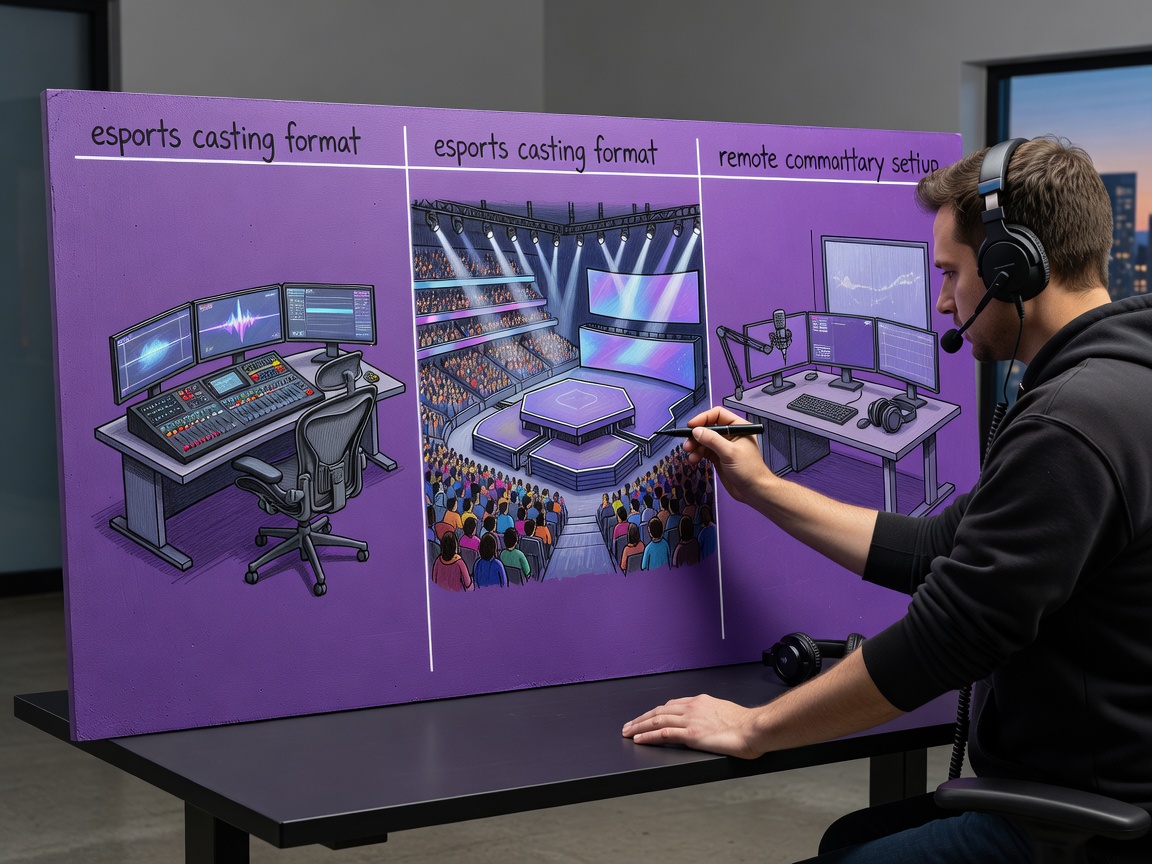
Then describe the production itself: studio or remote, live audience or none, programme length, match structure and the amount of unscripted time. A DreamHack festival segment may need someone comfortable with a busy public environment. A tightly timed championship desk may place more weight on concise moderation. These are assignments, not personality rankings. The same person may excel in both, but the evidence should address each setting.
 Brief before shortlist
Go beyond the highlight reel
A reel is useful for navigation, but it is a deliberately edited sample. Request links to complete, relevant segments with the person’s role and contribution identified. Watch a standard opening, a low-action period, a complicated explanation and a transition under pressure. Avoid judging technical faults outside the contributor’s control as if they were performance failures. Ask what happened before drawing a conclusion from an isolated clip.
Use a small set of job-related criteria: accuracy, clarity, timing, listening, collaboration and response to direction. Record examples rather than impressions such as “good energy”. For an analyst, note whether the replay supports the argument. For a host, note whether a question produces a useful answer. For a commentator, note whether the audience can follow the decisive action. Apply the same criteria to every candidate for that assignment.

Check the pairing, not just the person
Two excellent commentators can still create a crowded broadcast if their pacing and instincts overlap. Review shared work where possible. If a pairing is new, discuss handoffs, preferred cues, pronunciation preparation and how corrections will be handled. A short, clearly scoped rehearsal can reveal practical questions. If an assessment involves substantive work, agree its terms rather than treating a speculative production contribution as an unlimited free audition.
Do not use chemistry as an unexplained veto. Translate it into observable behaviour: missed openings, persistent interruption, unequal speaking time or difficulty accepting direction. Consider whether the show format is creating the problem. A desk with too many contributors and no defined lead can make capable people appear ineffective. Casting and format design should inform each other rather than forcing every difficulty onto the talent.
Verify credits without inventing certainty
Official broadcasts, event pages and published programme credits can help verify previous work. LoL Esports, VALORANT Esports, ESL and BLAST provide primary material about their competitions. A public appearance shows that someone worked on that production; it does not prove the exact contract, their present availability or the identity of a current representative. Ask the contributor or authorised representative to confirm details relevant to the new engagement.
References can add context about preparation and collaboration, but obtain permission before sharing personal contact details. Avoid collecting unrelated personal information or making selection decisions from rumours. If concerns arise about professional conduct, use a documented, proportionate process with an opportunity to clarify facts. Audience size and social engagement may matter to a specific promotional objective, but neither is a substitute for the core broadcast responsibilities.
Send a brief someone can answer
A useful enquiry states the game, role, dates, time zone, venue or remote arrangement, rehearsal plan, programme language, distribution and expected deliverables. Include who is producing the event, who will sign the agreement and a budget range when possible. Distinguish a request for availability from a confirmed offer. Tell the recipient when a decision is expected and which details remain provisional.
For emerging talent, the equivalent is a concise evidence pack: a role statement, a small set of relevant full segments, accurate credits and a reliable contact route. Explain what you contributed when several voices appear. Do not claim an official relationship because you cast a community watch party or covered an event independently. A clear account of modest experience is more useful than a polished description that cannot survive a basic credit check.
Useful primary starting points: DreamHack, LoL Esports, VALORANT Esports and BLAST. Our assessment criteria are editorial guidance, not an industry certification.
Next: get the team ready for transmission